The photos of the lot are informative and indicative, and cannot provide a highly detailed view of the object from all angles. We recommend a careful physical inspection of the lot before bidding.
ȘUȘARĂ, Pavel, "Corneliu Baba. A painter from the East?", Official Monitor, Bucharest, 2013
MUSCALU-ALBANI, Maria, "Confessions and Journals, volume II: 1965-1977", Official Monitor, Bucharest, 2020
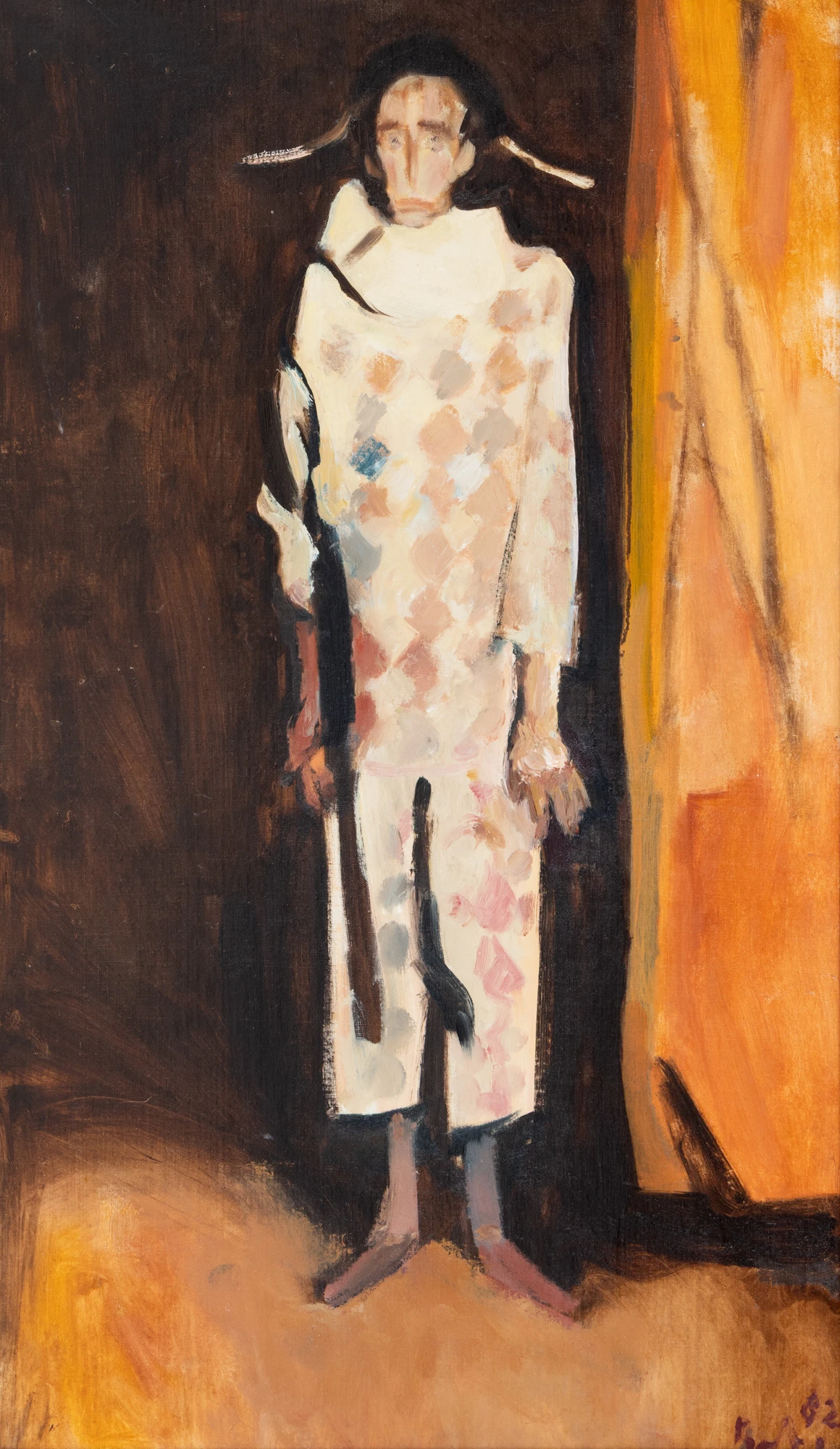
oil on canvas glued to cardboard, 66 x 38 cm, signed and dated bottom right, in black, "Baba, (19)82"
Notes
on the back, signed, titled and dated in black, "Corneliu Baba, Study for a harlequin, 1982"
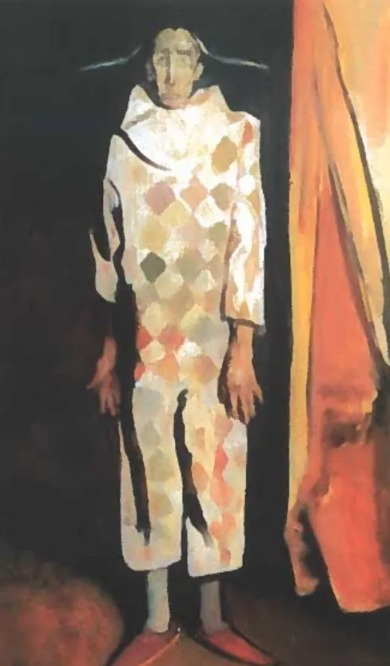
Corneliu Baba stated countless times that his preference is to paint people. For the artist, the portrait, with its imprinted features and its specific preference to betray the hidden characteristics of nature, is a summum, which obliges introspection and assiduous research to authentically render human sensitivity. Often serious or fearful, Corneliu Baba's portraits are unmistakable. The presence of the people painted by Baba surpasses the canvas or any rudimentary observation mechanism, prompting the viewer to dream and to move away from their own theories. The impressive suite of Harlequins, derived from portraiture, is a commanding meditation on the human condition. A favorite plastic subject of artists like Picasso or Cezanne, the harlequin has been omnipresent in art, generating favorable circumstances for the research of human splits. For master Corneliu Baba, during the '70-'80s, the harlequin became the opportunity for inexhaustible chromatic attempts. Thus, in the series dedicated to the harlequins, we can observe the artist's predilection for dark backgrounds, to contrast with the dramatic color accents. The present work, titled "Harlequin", shows Corneliu Baba's interest in the absolute model of human ambiguity. The Harlequin is known for his existence, which lies at the antipodes between the ludic and dramatic. His fateful sadness is masked by pronounced colors and the artificiality of his costume. The master said of his anonymous friend, "Harlequin," that he "[...] represents a human type of sad comedy". The ”Harlequins” suite is omnipresent in the notations from the artist's diary. Often returning to the same canvas, Baba noted each modification made to the harlequins, from their colorful and geometric costumes to the importance of the white collar. In a note made in his diary, Corneliu Baba also mentions the person who was going to pose for the harlequin, Sandra. Despite the existence of a confirmed model, according to his diary, Corneliu Baba emphasized the general character of the pale harlequins in his works, as they offer Baba the opportunity to move from the particular to typology. In the present work, the harlequin is withdrawn into gloom, with his hands along his body, surprised in repose. His face betrays a crushing loneliness, and his body is rigid under the flamboyant costume. His colorful costume, with shades of ochre, pink, blue, and purple, contrasts with the closed background behind the curtain. This chromatic duality is specific to the harlequin. The differences in color render the coexistence of the ludic with the dramatic under the same mask.
For clarifications regarding the bidding procedure, hammer price costs, guarantee, payment, and collection terms for the winning lot, we recommend carefully reading/re-reading the Bidding Regulations.
For additional information regarding the lot and the auction, please contact the Art Consultants Department.
By choosing "Accept all cookies" you agree to the use of cookies to help us provide you with a better user experience and to analyse website usage. By clicking "Adjust your preferences" you can choose which cookies to allow. Only the essential cookies are necessary for the proper functioning of our website and cannot be refused
Cookie settings
Our website stores four types of cookies. At any time you can choose which cookies you accept and which you refuse. You can read more about what cookies are and what types of cookies we store in our Confidentiality Policy.
are necessary for technical reasons. Without them, this website may not function properly.
are necessary for specific functionality on the website. Without them, some features may be disabled.
allow us to analyse website use and to improve the visitor's experience.
allow us to personalise your experience and to send you relevant content and offers, on this website and other websites.